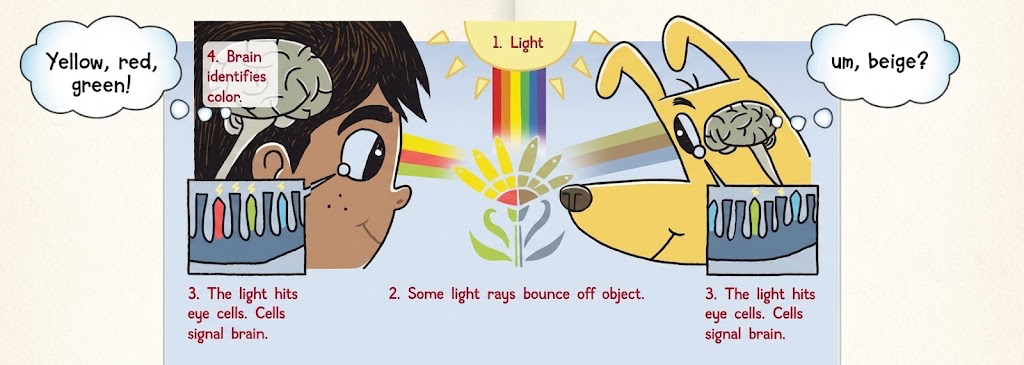
Zachary shoves a picnic lunch into a basket and heads out for his favorite spot in the park. His dog, Mutt, races ahead of him. The neighbor's cat, Kit, tags along behind.
It's a beautiful day, and their senses are hard at work taking in the spring afternoon. If you could get inside their heads, what would you find? Would they be smelling, hearing, feeling, seeing, and tasting the same things?
In a nest under a pile of branches, a wood rat wakes from a nap and scratches. Each scratch releases odors - chemicals from the rat's skin that drift through the air. Close to the rat, the air is dense with them. But the molecules spread out as they drift away.
A few scent molecules hit Mutt's nose. The smell is faint, but that's all it takes. Mutt's nose sends a message to his brain: Rat near!
Dogs are incredible sniffers. Their noses hold up to 300 million scent sensors. Dogs can identify and remember millions of different smells, and can track many smells at the same time.
Dogs also smell through each nostril separately, so they can tell which direction a smell is coming from. Mutt races toward the brush pile.
A cat's nose also packs in plenty of scent receptors, about 200 million. Both cats and dogs can hold air in their noses while they keep breathing in and out. This gives them extra time to identify odors. Kit also heads for the rat.
Zachary tugs Mutt away from the brush pile. With a measly 5 million scent detectors, Zachary has no idea what the dog and cat are smelling.
As they near the park, all three can hear birds calling. But Kit listens most intently. Cats are hunters. They use their sharp hearing to find prey.
Cats, dogs, and humans can hear sounds about as low as the bottom key on a piano. But dogs can hear higher notes than humans. And cats can hear even higher notes than dogs.
A cat's ears can catch 11 full octaves. That means Kit can hear the scurry of beetles, the squeaks of mice talking to their babies, and even the ultrasonic peeps of bats. When a cat's ears twitch, it's likely hearing sounds that you can't.
Different animals can hear different kinds of sounds. Some hear low notes better, and some hear high notes better. Sound is measured in hertz, or Hz.
As Zachary takes a short cut through a clump of bushes, wet leaves stick to his hands. A rough branch brushes his shoulder. Like all animals, Zachary feels with a network of touch sensors spread all over his body. Nerves in the skin sense pressure, heat, wet, and dry. Sensors inside muscles feel stretching and moving, temperature and pain.
Mutt and Kit find their own way through the shrubs. Like Zachary, their nerves tell them what they're touching and how they're moving.
Zachary uses his eyes to see a branch about to hit him. But cats and dogs don't see well right in front of their faces. Instead, they sense nearby objects with stiff whiskers called vibrissae. Nerves around the base of each whisker feel how it bends.
As their whiskers brush against the bushes, Kit and Mutt get a "touch picture" of what's around them. Kit knows if his whiskers fit through an opening, then the rest of him can squeeze through.